The Stream of Life by Clarice Lispector
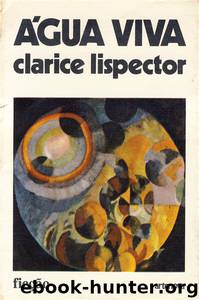
Author:Clarice Lispector [Lispector, Clarice]
Language: eng
Format: epub
Published: 2011-08-15T16:00:00+00:00
Afterword
Hélène CIXOUS
Translated by Verena CONLEY
Is the text readable? One may have to find other modes, other ways of approaching it: one can sing it. One is in another world. The text does not keep, hold back, and one cannot retain it. Does this mean it is only water? Absolutely not. It is living water, full water. It escapes the first rule of text. It is not linear, not formally constructed whereas most other texts by Clarice Lispector are somehow constructed. As there is no story, one can start anywhere, in the middle, at the end. There is no exterior border. But there are a good many interior borders; there are some very precise ones that could be drawn. They have to do with the infinite line of separation between moments, epiphanies. There are no borders of montage, as in Joyce. The text is without ruse. It is always a question of beginnings. It is hard to imagine a text that would be more violently real, more faithfully natural, more contrary to classical narration. Classical narration is made of appearances, caught in codes. Here there are no codes. Yet Clarice is not mad; there are living codes with a beginning and an end. She says it: Now I begin, now I close, I leave and I come back. The text follows movements of the body and enunciation, but it also follows thematics. Rather than a narrative order, there is an organic order.
There are keys for reading. In Close to the Savage Heart, Clarice Lispector says that she continues to open and close circles of life. In Agua viva (The Stream of Life), she performs this statement. The question, constantly raised—because there is no life without somebody to live it—is: Who lives? Who lives there? "To pray, is to throw yourself in this transfiguring arch of light which spans from what goes by to what is about to happen. It is to melt in it in order to lodge one's infinite light in the fragile little cradle of individual existence." To pray is to call for Clarice. It is to throw oneself into this arch of light. That is what renders a reading so difficult. One cannot talk about Agua viva. One has to take a leap at the very moment at which what could be called "a now-instant'' or "an instant-already" is about to reveal itself. The only thing to do is to delve into the luminous arch. One has to give oneself to that which gives itself.
In Close to the Savage Heart, Clarice had recourse to the geometric form of the circle of life. Agua viva is its realization and its representation, which in style is rendered through the ubiquitous gerunds and present participles. The problem is that to delve into "the instant-al- ready" is complicated by the fact that we deal with depth and that the latter cannot be measured by the watch alone. Themes relate to life: there is the constant inscription of birth in innumerable ways. It
Download
This site does not store any files on its server. We only index and link to content provided by other sites. Please contact the content providers to delete copyright contents if any and email us, we'll remove relevant links or contents immediately.
Red by Erica Spindler(12687)
Crooked Kingdom: Book 2 (Six of Crows) by Bardugo Leigh(12436)
Twisted Palace by Erin Watt(11256)
Mindhunter: Inside the FBI's Elite Serial Crime Unit by John E. Douglas & Mark Olshaker(9497)
Fangirl by Rainbow Rowell(9438)
Never let me go by Kazuo Ishiguro(9082)
All the Light We Cannot See: A Novel by Anthony Doerr(8569)
A Man Called Ove: A Novel by Fredrik Backman(8526)
The Lover by Duras Marguerite(8031)
Confessions of an Ugly Stepsister by Gregory Maguire(7988)
Little Fires Everywhere by Celeste Ng(7353)
The Vegetarian by Han Kang(6385)
To All the Boys I've Loved Before by Jenny Han(5931)
The Shadow Of The Wind by Carlos Ruiz Zafón(5796)
On the Yard (New York Review Books Classics) by Braly Malcolm(5568)
Keepsake: True North #2 by Sarina Bowen(5469)
Dancing After Hours by Andre Dubus(5347)
Ken Follett - World without end by Ken Follett(4844)
The Perks of Being a Wallflower by Stephen Chbosky(4743)
